
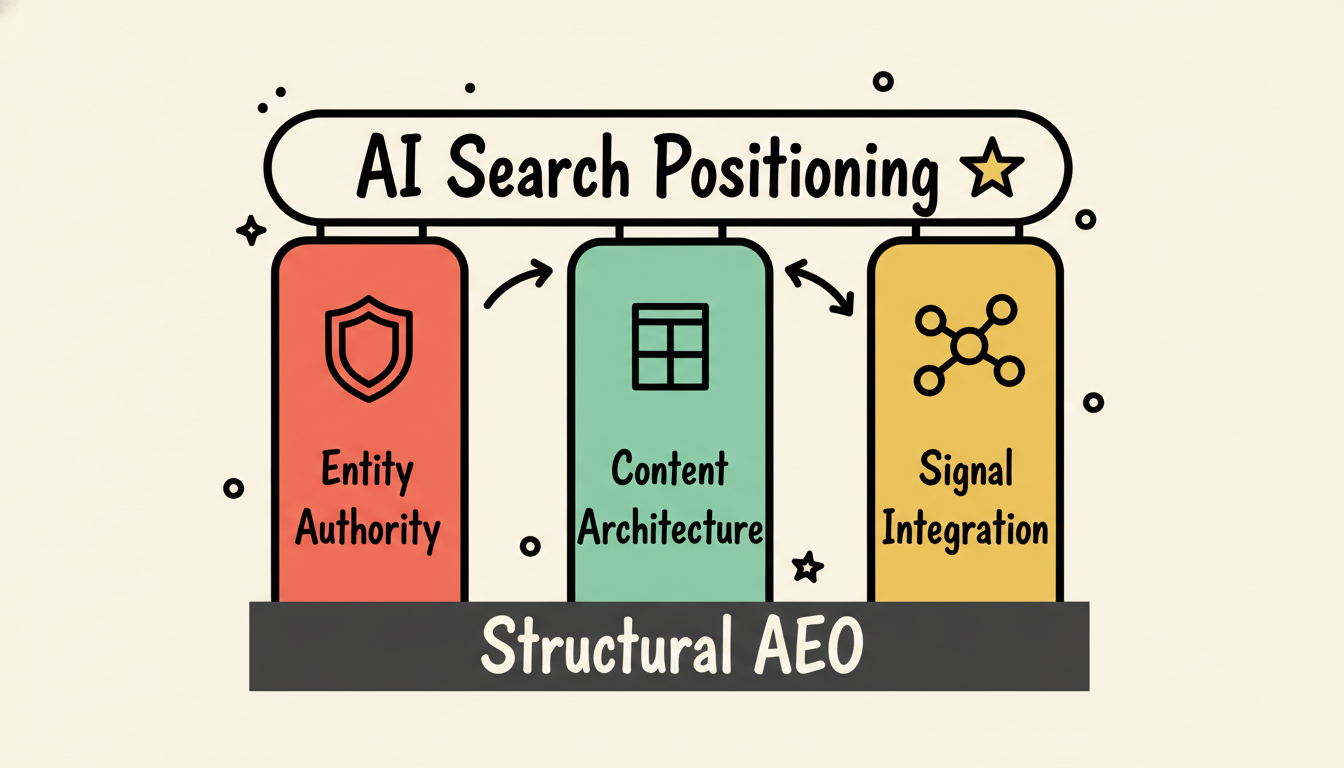
Most brands chase AI search visibility with tactics. They add schema markup, rewrite headers, and publish FAQ pages. These actions help. But without a structural framework, they produce inconsistent results that fade when the algorithm shifts.
Effective answer engine optimization rests on three pillars. Neglect any one and the other two cannot compensate.
Why Tactics Without Structure Fail
Tactical AEO is reactive. You see a competitor appear in an AI answer, you reverse-engineer their approach, and you copy it. This works until the model updates its synthesis criteria. Then you start over.
Structural AEO is proactive. You build the foundational elements that AI models consistently reward regardless of specific algorithm changes. The tactics change. The pillars do not.
Chasing individual AI citations is like chasing individual keyword rankings. You might win a few, but without a systematic approach, you cannot hold them.
Pillar One: Entity Authority
AI models do not evaluate individual pages in isolation. They evaluate your brand as an entity across the entire web. Your entity authority determines whether AI models consider you a credible source for any given topic.
Building Entity Authority
- Consistent structured data across your website, third-party profiles, and industry directories. Every mention of your brand should present the same core facts in parseable formats.
- Credentialed expertise signals. Author bios with verifiable credentials. Company profiles with demonstrated industry experience. Case studies with specific metrics rather than vague testimonials.
- Cross-platform presence. AI models triangulate authority from multiple sources. A brand that appears authoritatively across its own site, press coverage, review platforms, and industry publications builds stronger entity authority than one optimized only on its own domain.
Entity authority compounds over time. Each consistent signal reinforces the model’s confidence in your brand. This is why companies with deep ecosystem experience, those that have scaled hundreds of companies across multiple stages, build entity authority faster. They have more signals to draw from.
Pillar Two: Content Architecture
The structure of your content determines how effectively AI models can extract and cite your information. Raw quality matters, but structure determines whether that quality reaches AI-generated answers.
Building Content Architecture
- Question-based hierarchy. Map every content piece to a specific question your audience asks. Organize content in clear topic clusters with parent pages linking to detailed subtopic pages.
- Structured answer formats. Use headers, lists, tables, and definition structures that AI models can parse cleanly. AI synthesis works best when the source material is already organized for extraction.
- Freshness systems. AI models favor current content. Build automated review cycles that flag outdated statistics, broken citations, and superseded recommendations. A content architecture without freshness processes decays rapidly.
- Full-funnel coverage. Cover your topic at every intent level: informational, evaluative, and transactional. Brands that only publish top-of-funnel content miss the high-intent queries where AI citations drive actual revenue. The aeo services providers delivering measurable results understand that content architecture must span the entire buyer journey.
Pillar Three: Signal Integration
Entity authority and content architecture mean little if your marketing channels work in isolation. The third pillar connects every channel into a unified system that amplifies AI search positioning.
Building Signal Integration
- Paid media feeds organic authority. Branded search campaigns generate the query volume that signals relevance to AI models. Without paid media creating demand, organic content has less signal to capture.
- Organic content validates paid messaging. When AI models cite your content, it validates the claims your paid campaigns make. This creates a trust loop between channels.
- Attribution connects everything to outcomes. Without data-driven attribution modeling, you cannot identify which signals drive AI citations and which waste budget. CAC optimization requires visibility across all channels simultaneously.
- Speed of execution matters. Integrated strategies fail when teams move at different speeds. Paid, organic, and AI optimization must execute in coordinated sprints. Partners experienced with venture-backed companies understand this urgency and build aeo services programs that move at startup speed.
Putting the Pillars Together
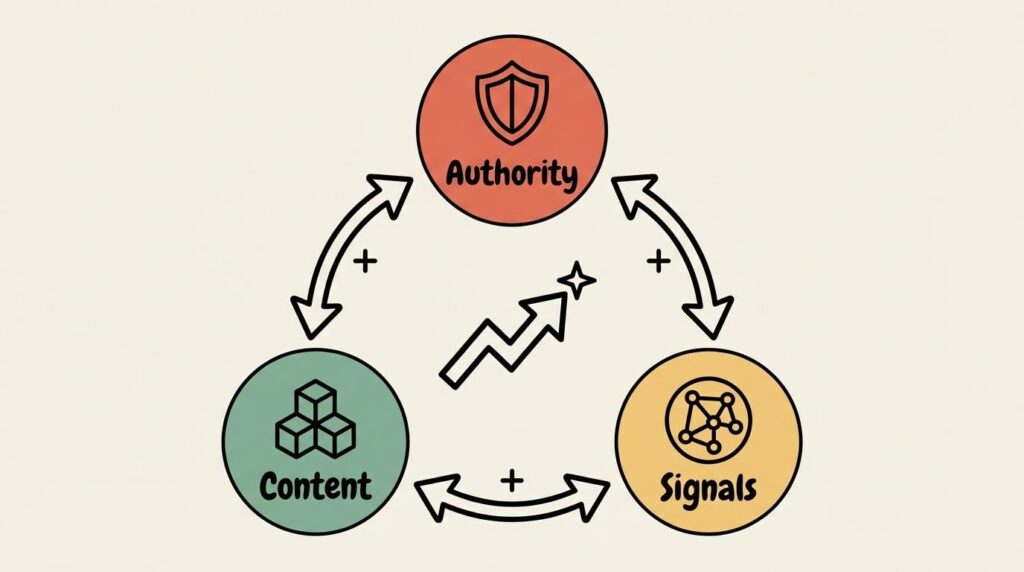
- Audit all three pillars. Score your entity authority, content architecture, and signal integration independently. Identify which pillar is weakest.
- Fix the weakest pillar first. Improvements to your weakest pillar produce the largest marginal gains. A brand with strong content but weak entity authority should invest in authority building before publishing more content.
- Build feedback loops between pillars. Content updates should strengthen entity signals. Paid campaigns should drive queries that content captures. Attribution data should inform which content and campaigns deserve more investment.
- Measure pillar health quarterly. Track AI search citations, entity consistency scores, content freshness rates, and cross-channel attribution. Decline in any pillar predicts future visibility loss.
The Structural Advantage
Brands that build all three pillars create a structural advantage that tactical competitors cannot replicate quickly. Individual tactics can be copied in days. A three-pillar system takes months to build and years to match.
This structural moat widens over time. Each quarter of integrated execution strengthens all three pillars simultaneously. Competitors starting from scratch face a compounding deficit that grows with every cycle.
The question is not whether to invest in AI search positioning. The question is whether you build it on a structural foundation or chase tactics that expire with the next model update. The pillars endure. The tactics do not.