
Table of Contents
- Executive Summary: The Fiber Identification Imperative
- Fiber Fundamentals: Origins and Molecular Blueprints
- The Burn Test: A Definitive First-Line Analysis
- The Microscopic Examination: Seeing the Unseen Structure
- Chemical and Solubility Tests: Laboratory-Grade Verification
- The Sensory and Performance Test: The “Hand Feel” and Behavior Audit
- Application-Specification Matrix: Matching Fiber to End-Use
- Sustainability and Market Intelligence: The Modern Sourcing Context
- Building a Practical Verification Protocol for Your Business
- Conclusion: Precision as a Competitive Advantage
1. Executive Summary: The Fiber Identification Imperative
For industrial buyers and product developers, the accurate identification of wool, polyester filament, and pure cotton is a non-negotiable core competency. It is the foundation of quality assurance, cost management, regulatory compliance, and successful product development. Wool, Polyester Filament, and Pure Cotton: The Procurement Manager’s Guide to Fiber Identification, Sourcing, and Application Mistaking a high-cost specialty fiber for a commodity alternative, or failing to detect an undisclosed blend, directly impacts profit margins, product performance, and brand reputation.
This guide provides a multi-method framework for distinguishing these three critical fibers. We move beyond simple descriptions to a practical, data-backed methodology combining quick field tests, detailed microscopic analysis, and an understanding of fundamental polymer science. This knowledge empowers you to verify supplier claims, troubleshoot production issues, and make informed sourcing decisions that align technical fiber properties with specific end-use requirements across apparel, home furnishings, and industrial textiles.
2. Fiber Fundamentals: Origins and Molecular Blueprints
Understanding the origin of each fiber explains its inherent behavior.
- Wool: A natural protein fiber harvested from sheep. Its polymer chains are made of amino acids (keratin), linked by both strong covalent bonds and weaker hydrogen and salt bridges. This structure gives wool its unique elasticity and felting potential. A key metric is fiber diameter, measured in microns (μm). Finer merino wool may be 17-21μm, while coarser carpet wool can exceed 30μm.
- Polyester Filament (PET): A synthetic polymer derived from petrochemicals (purified terephthalic acid and monoethylene glycol). It consists of long, linear, highly regular chains of esters, resulting in high crystallinity. “Filament” denotes continuous strands of great length, as opposed to short “staple” fibers, giving fabrics a characteristically smooth feel.
- Pure Cotton: A natural cellulose fiber from the seed hair of the Gossypium plant. Its polymer is cellulose, a chain of glucose molecules with abundant hydroxyl (-OH) groups. These groups make cotton hydrophilic. Fiber quality is graded by staple length: long-staple (e.g., Pima, Egyptian, >28mm) is superior to short-staple (<25mm).
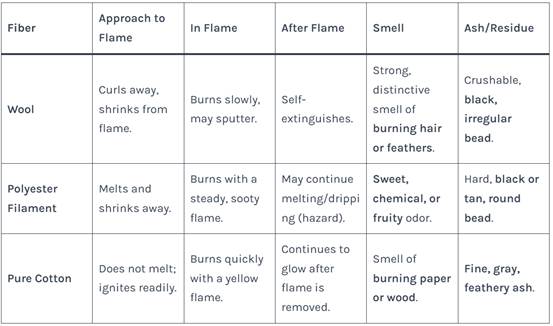
3. The Burn Test: A Definitive First-Line Analysis
The simplest and most telling test. Always conduct in a safe, well-ventilated area with tweezers and a flame source.
4. The Microscopic Examination: Seeing the Unseen Structure
A microscope (100-400x) reveals the defining physical architecture.
- Wool: Surface shows overlapping scales (cuticles). The cross-section is roughly circular or oval, and the fiber diameter varies naturally along its length. Medullated fibers (coarse wools) may show a central canal.
- Polyester Filament: Perfectly smooth, rod-like surface with no markings. Cross-section is uniformly round (standard) but can be engineered into trilobal, hollow, or other shapes for specific functions.
- Pure Cotton: Appears as a flat, twisted ribbon (the “convolutions”). The cross-section is kidney-bean shaped, and the lumen (central canal) is often visible.
5. Chemical and Solubility Tests: Laboratory-Grade Verification
These tests provide conclusive evidence and can quantify blends.
- Acid Test (70% Sulfuric Acid): A key differentiator. Cotton dissolves rapidly at room temperature. Wool is resistant to cold dilute acid but dissolves in hot concentrated acid. Polyester is highly resistant to cold sulfuric acid.
- Alkali Test (5% Sodium Hydroxide): Wool dissolves in boiling 5% NaOH. Cotton and Polyester are stable in cold or warm alkali, though cotton’s strength is degraded by hot, concentrated alkali.
- Solvent Test (M-Cresol or Dimethylformamide): Polyester dissolves in hot m-cresol or DMF. Wool and Cotton are insoluble. This is a definitive test for separating polyester from natural fibers.
6. The Sensory and Performance Test: The “Hand Feel” and Behavior Audit
Trained senses and simple physical tests offer powerful clues.
- Hand Feel & Drape:
- Wool: Often has a slight crispness or spongy resilience. Warm to the touch. Drape is fluid but with body.
- Polyester Filament: Can feel smooth, slick, or soft depending on finish. May feel “cool.” Drape can be fluid (in lightweight weaves) or stiff.
- Pure Cotton: Generally has a soft, slightly dry, or matte hand. Absorbent feel.
- Moisture Behavior: Drop water on the fabric. Cotton absorbs instantly, spreading widely. Wool absorbs slowly but can hold a large amount without feeling wet. Polyester repels water (beads up), unless treated with a hydrophilic finish.
- Crush Recovery: Crush a section of fabric in your fist for 10 seconds. Wool springs back well. Polyester typically recovers excellently. Cotton holds creases more readily.
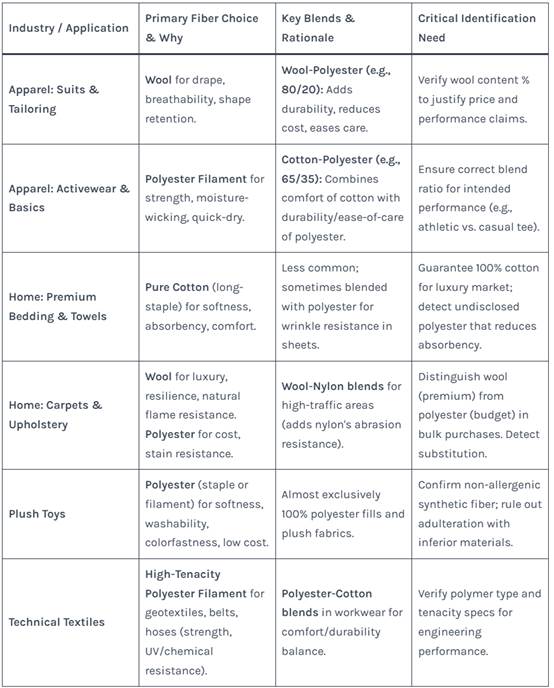
7. Application-Specification Matrix: Matching Fiber to End-Use
8. Sustainability and Market Intelligence: The Modern Sourcing Context
Fiber choice is increasingly driven by sustainability narratives and market trends.
- Wool: Promoted as renewable, biodegradable, and natural. Traceability (e.g., Responsible Wool Standard) is key. Price is volatile, tied to agricultural factors.
- Polyester: Criticized as petroleum-based but evolving. Recycled Polyester (rPET) from bottles is a major growth area, certified by GRS (Global Recycled Standard). Offers price stability vs. natural fibers.
- Cotton: Faces scrutiny over water and pesticide use. Organic cotton (GOTS-certified) and Better Cotton Initiative (BCI) cotton are essential for sustainable sourcing.
- Procurement Insight: Always request certification documentation (GRS, GOTS, RWS) and Transaction Certificates to validate claims in the supply chain.
9. Building a Practical Verification Protocol for Your Business
A tiered approach is most efficient.
- Tier 1: Incoming Goods Check (Fast, Non-Destructive):
- Perform sensory/hand feel assessment.
- Conduct moisture drop test.
- Examine labels and documentation.
- Tier 2: Quality Control Lab (Destructive, Confirmatory):
- Perform the Burn Test on a small snippet from a seam or hem.
- Use a portable microscope (~$200-500) for quick visual verification.
- Tier 3: Third-Party Laboratory (For Disputes or Blends):
- Send samples for Fourier-Transform Infrared (FTIR) Spectroscopy—the gold standard for polymer identification.
- Request quantitative blend analysis via chemical dissolution (AATCC Test Method 20A).
10. Conclusion: Precision as a Competitive Advantage
In a complex global market, the ability to accurately distinguish wool, polyester filament, and pure cotton transforms from a technical skill into a strategic business advantage. It protects against fraud, ensures product integrity, and enables you to precisely engineer materials for their intended purpose. By implementing a systematic identification protocol—from the simple burn test to leveraging modern certifications—you secure not just your supply chain, but also the trust of your customers and the performance of your products. Mastery of fiber identity is the first, and most critical, step in mastering the textile business.